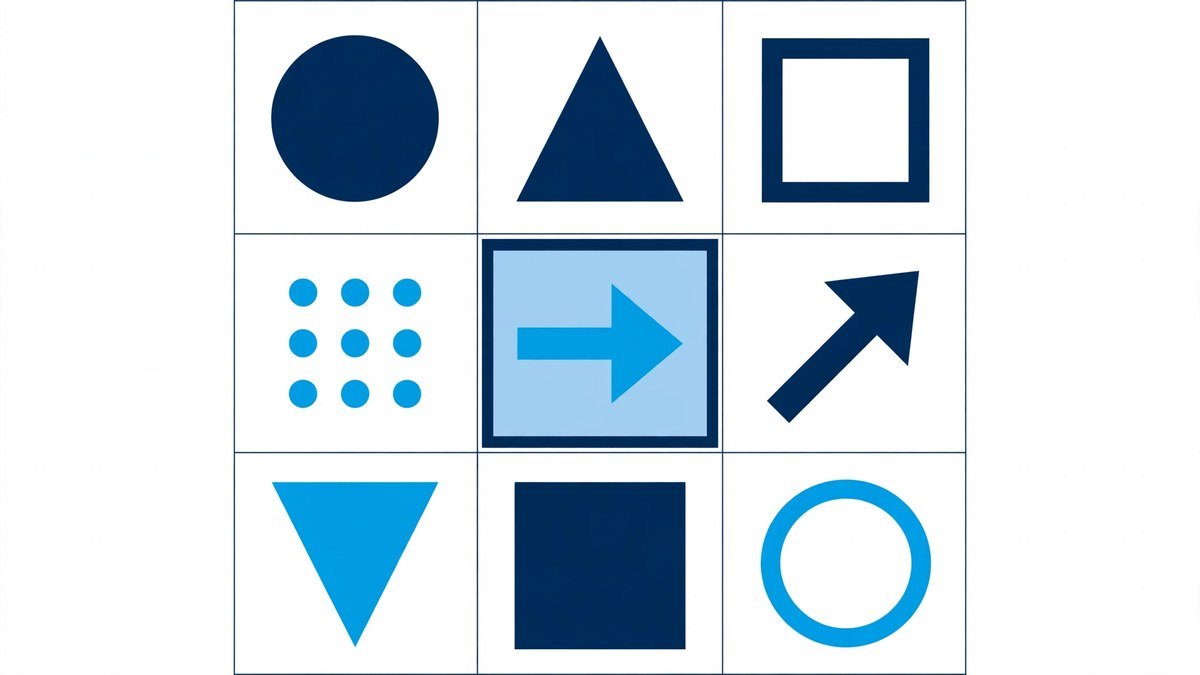
Most candidates fail abstract reasoning tests for a simple reason: they search for the pattern at random. A fixed method beats raw talent here, and the tips below are that method. They work on SHL, Korn Ferry, Criteria and Aon tests alike, because every publisher builds questions from the same small set of rules. Try the free pattern recognition test on our homepage first to see where you stand, then use the checklist below on our abstract reasoning practice test and watch your speed improve.
Abstract reasoning tests look strange at first: rows of shapes, dots and lines with no words and no numbers to calculate. Once you know the rules that build them, they become predictable. This guide gives you the full method: a checklist, time rules, three worked examples, the seven costliest mistakes, a seven day plan, and a small measurement of my own showing which rules actually decide questions.
What an abstract reasoning test actually measures
An abstract reasoning test is a timed, multiple choice test made entirely of pictures. Each question shows a pattern and several possible answers, and only one answer follows the same rule as the pattern. The test measures fluid reasoning: your ability to spot rules, apply them and learn from new information. Employers use it because it predicts how fast someone learns new systems and solves unfamiliar problems, without testing school knowledge or vocabulary. You cannot revise facts for it, but you can train the method.
Most tests use five formats: series (the next figure in a row), matrix (the missing cell in a grid, usually 3 by 3), odd one out, analogies, and sets (which figures belong to group A or B). The checklist below works on all five, because the rules behind them are the same.
Tip 1: Run the same 7-step checklist on every question
Searching at random is the biggest time sink in these tests. Check the rules in the same order every time, cheapest first, and confirm each rule on at least two steps before you trust it.
- Count. Count shapes, sides, dots, lines or enclosed spaces and write a number under each frame. A run such as 2, 3, 4, 5 is a steady change. A run such as 2, 3, 2, 3 is an alternation. Counting takes about two seconds and decides more questions than any other single check.
- Position and movement. Number the possible positions, for example the four corners, and note where each element sits in every frame. Movement is almost always a fixed number of steps in a fixed direction, so one inconsistent step means you have the wrong rule.
- Rotation. Pick one lopsided feature, such as a notch or an arrowhead, and track only that. Check that the turn is the same size and direction at every step. Common turns are 45, 90 and 180 degrees, clockwise or anticlockwise.
- Reflection. If the parts of a shape have swapped sides, it is a reflection, not a rotation. A turn never changes the order of features around a shape, but a flip reverses it. This is the most useful distinction to practise, because a turned shape and a flipped shape look almost identical at speed.
- Steady change. Size, number of sides, line thickness or the amount of shading grows or shrinks by a fixed step. State the step in words, then apply it to the last frame.
- Combination. When two frames combine to make a third, test three rules: keep everything (union), keep only what both frames share (intersection), or keep only what appears in one of the frames (difference).
- Shading and size. Try alternation and fixed cycles first, such as black, grey, white, black, grey, white. If neither works, test whether the shading depends on something else, for example every shape with an even number of sides is black.
Anything that stays identical in every frame is there to take up your attention. Note it once, then ignore it. When two rules run at once, which is normal beyond the easiest questions, you will find the first rule quickly and then stall. That stall is your signal to go back to the checklist and carry on down it, not to stare harder at the frames. For the five geometric rules in detail, see our guide to 5 geometric rules in abstract reasoning.
Tip 2: Predict the answer before you look at the options
Describe the missing figure in words before you look at the options: white square, dot in the top right corner, four lines. Then look for that exact figure. This stops the distractors from pulling you into second guessing, which is where a lot of time disappears. Distractors are usually built to satisfy exactly one of the two rules, so a candidate who only found one rule will pick one of them. If no option matches your prediction, your rule is wrong: go back to the checklist instead of picking the closest match.
Tip 3: Eliminate with one rule, then compare what is left
You do not need the complete rule to rule options out. As soon as you are sure of one rule, strike out every option that breaks it. If the dots clearly increase by one, any option with the wrong count is gone, even if you have not worked out the rotation yet. Often this leaves two options, and comparing those two directly points to the second rule. It is fastest to compare the options with each other first: if all four show the same shape in different colours, the shading rule decides the item. If two are mirror images of each other, reflection is involved.
Tip 4: Work out your time budget before you start
Speed only means something relative to your test, so work out the average time per question before you start practising. Then set two numbers: your target time, about 75 percent of the average, and your ceiling, about twice the average. Hitting the ceiling means guess and move on.
| Test style | Typical format | Average per question |
|---|---|---|
| SHL inductive or abstract reasoning | 24 questions, 25 minutes | About 60 seconds |
| Criteria CCAT, fast mixed cognitive test | 50 questions, 15 minutes | 18 seconds |
| Standard inductive or abstract test | 20 to 30 questions, 20 to 25 minutes | 45 to 60 seconds |
| Untimed IQ style matrices | Varies | No hard limit |
Formats vary, so check your invitation email for the exact numbers. Two minutes on one hard question can cost you three easy ones at the end. Accuracy comes first, but only up to a point: getting 18 of 20 attempted questions right beats getting 12 of 12 right when there were 24 questions.
Tip 5: Never leave a blank when guessing is free
Most employer tests do not deduct marks for wrong answers, so a blank scores the same as a wrong guess and worse than an educated one. Read the instructions before you start: if your test does penalise wrong answers, the instructions will say so, and you should skip rather than guess. When guessing is free, eliminate what you can, pick the best remaining option and move on once you pass about twice your average time.
Tip 6: Keep an error log, not just a score
After each practice set, write down every wrong answer and the kind of rule it involved: counting, movement, rotation, reflection, steady change, combination, shading or size. After a couple of sets, most of your mistakes will sit in one or two of those, and practising those rules is what moves your score. Your total score on its own tells you very little you can act on.
Log each miss in four columns: date, rule type, what went wrong, and the fix to practise.
Short sessions of 15 to 25 minutes on one rule type work better than long, unfocused ones. Practise in blocks of 8 to 10 questions with a timer set to your test pace, then review every miss straight away. The immediate review builds the pattern memory that makes you faster.
Tip 7: Prepare the day before, not on the morning
Most candidates lose marks before the first question. Read your invitation the day before and note the test publisher, the number of questions, the time limit and whether wrong answers lose marks. Confirm your device, browser and internet connection if the test is online, and keep your ID ready if the test is supervised. Sleep properly: one tired morning costs more marks than one extra evening of practice gains. On the day, use the practice questions at the start of the test to settle into the format. If a question looks impossible, it may be one of the hard ones placed early. Skipping it is a strategy, not a failure.
Three worked examples
Work through these slowly first, then time yourself on a second pass.
Example 1: a series with two rules
Four frames each show a circle with an arrow inside and a row of small dots below it. Frame 1: arrow points up, 1 dot. Frame 2: arrow points right, 2 dots. Frame 3: arrow points down, 3 dots. Frame 4: arrow points left, 4 dots.
Counting first: 1, 2, 3, 4, so frame 5 has 5 dots. Rotation second: the arrow turns 90 degrees clockwise each time, so from left it wraps back to up. The answer is an arrow pointing up with 5 dots. Expect one wrong option with 5 dots and the arrow pointing down, and another with the arrow right and 4 dots. When two rules run together, the distractors usually satisfy exactly one of them.
Example 2: a matrix that combines cells
In a 3 by 3 grid, the third cell in each row is built from the first two.
| Cell 1 | Cell 2 | Cell 3 | |
|---|---|---|---|
| Row 1 | Vertical line, circle | Horizontal line, circle | Vertical line, horizontal line |
| Row 2 | Triangle, square | Square, star | Triangle, star |
| Row 3 | Circle, cross | Cross, arrow | ? |
Test the three combination rules on row 1. Union would keep the circle, and cell 3 has no circle, so union is out. Intersection would keep only the circle, which is wrong too. Difference keeps what appears in exactly one cell: the vertical line and the horizontal line. That matches. Row 2 confirms it: the square is dropped, and the triangle and star stay. Now apply it to row 3. The cross appears in both cells and is dropped. The circle and the arrow each appear once and stay. The missing cell holds a circle and an arrow. For more matrix practice, see our matrix reasoning practice questions.
Example 3: an odd one out that turns on reflection
Five options each show the same L-shaped figure: a vertical bar with a short foot at the bottom and a small dot on the inside of the corner. Four are the figure turned to different angles. The fifth has been flipped over. Counting does not separate them, because every option has the same parts, and shading does not separate them either. The difference is which way round the figure is. Start at the corner in each option and trace the outline clockwise, noting whether you travel along the bar or the foot first. A turn never changes that order, but a flip reverses it. Four options give one order and the fifth gives the reverse. That fifth option is the odd one out.
What the numbers say: which rules actually decide questions
Advice is cheap, so I checked it against real questions. I took a published 8-question timed drill and scored each item by the rule that decides it. Counting alone decides 4 of the 8 items, half the set. Six of the 8 items need two rules at once, which is why finding one rule and stopping is the most common way to pick a distractor. Only 1 of the 8 turns on shading alone, and none turns on size alone. The lesson is simple: count first, then look for the second rule before you answer. The same drill sets its readiness mark at 7 or 8 correct inside 6 minutes, which is 45 seconds per item. If you score below 6, or take more than 8 minutes, drill the checklist untimed first and add the clock later. Most candidates see a clear improvement within one to two weeks of daily timed practice, because the common rules become familiar.
The 7-day plan
| Day | What to do | Timer |
|---|---|---|
| Day 1 and 2 | Learn the checklist in short, untimed sessions; say each check aloud | None |
| Day 3 and 4 | Untimed practice; name the rule type before you solve each question | None |
| Day 5 | Mixed practice with the clock running; enforce your ceiling | Strict |
| Day 6 | Review your error log and practise only your weakest rule type | Loose |
| Day 7 | One full test under exam conditions, then rest | Strict |
Seven mistakes that cost the most marks
- Spotting one rule and stopping. Most questions past the easy ones use two rules. The stall after the first rule is your cue to keep going down the checklist.
- Patching a failed rule. If your rule breaks on one step, go back to the checklist instead of adding an exception to save it.
- Starting with the hardest looking element. Count first. It is the fastest check and the most common deciding rule.
- Rechecking solved items. If the rule fits every step, answer and go. Save rechecking for items where you eliminated rather than solved.
- Treating every item as equal. Easy items should take half your average. Bank that time for the hard ones.
- Panicking after a hard item. One guess costs one mark. Losing focus for the next three questions costs more.
- Practising without a timer. Untimed practice teaches the rules but not the pace. Add the clock from day 5, or the real test will feel twice as fast as your practice.
Frequently asked questions
Do you need maths for an abstract reasoning test?
No. You may count sides or dots, but there is no arithmetic beyond that. The test measures pattern recognition and logic, not numerical ability.
Should you guess if you are stuck?
Yes, on almost every employer test. Most do not deduct marks for wrong answers, so a blank scores the same as a wrong guess. Eliminate what you can, pick the best remaining option and move on once you pass about twice your average time.
How long does it take to improve?
Most candidates see a clear improvement within one to two weeks of daily timed practice. Gains flatten after that, so spend the final days reviewing your error log instead of doing more questions.
What score do employers want?
There is no single pass mark. Most employers compare you with other candidates using a percentile, and a score around the 70th percentile or higher is competitive for most graduate and professional roles.
Do these tips work for inductive and SHL tests too?
Yes. Inductive tests use the same series and matrix logic, so the checklist applies directly. Our guide on how to prepare for an SHL inductive reasoning test covers the publisher specific details, and our step by step framework covers the method in full.
Put the tips into practice
The checklist only becomes fast through use. Take the free pattern recognition test on our homepage, then work through the abstract reasoning practice test with the checklist beside you. Log every miss by rule type, drill your weakest rule for a week, and sit a full timed test on day 7. That is the whole method, and it is the one that actually works.


