
Ravens Progressive Matrices are the most famous non-verbal IQ test in the world, used by Mensa, the military and employers for over 80 years. This guide explains the format, the rules and how to prepare, and you can practice on our Ravens Matrices Practice or the main visual pattern recognition test.
What Are Ravens Matrices?
Each question is a 3×3 grid of patterns with one tile missing. You choose the tile that completes the pattern from six or eight options. There are no words and no numbers, so the test works in every language.
John C. Raven published the first Progressive Matrices in 1936, with his colleague L. S. Penrose, as a test of what Raven called educative ability: the ability to make sense of complexity and find meaning in confusion. That is now called fluid intelligence. Because the items use shapes alone, the test is not tied to any language, vocabulary or school syllabus, which is why it is still used worldwide for research, recruitment and clinical assessment. The current edition, Ravens 2, is published by Pearson and is used in the same way.
The Three Versions: SPM, CPM and APM
There is not one Ravens test. There are three versions, and the sets work differently in each.
| Version | Items and sets | Time | Who takes it |
|---|---|---|---|
| SPM (Standard) | 60 items in 5 sets, A to E | 40 to 60 minutes, often untimed | Adults and children from age 6, the general screening version |
| CPM (Coloured) | 36 items in 3 sets, A, Ab and B | About 15 to 30 minutes | Children aged 5 to 11, and adults who need a simpler format |
| APM (Advanced) | Set I: 12 items, Set II: 36 items | Set II: 40 minutes, timed | Above-average adults, for selection and research |
The three sets A, Ab and B belong to the Coloured version. In the Standard version the five sets A to E get harder as you go: early sets are simple pattern completion, while the later sets combine several rules at once.
How Each Question Works
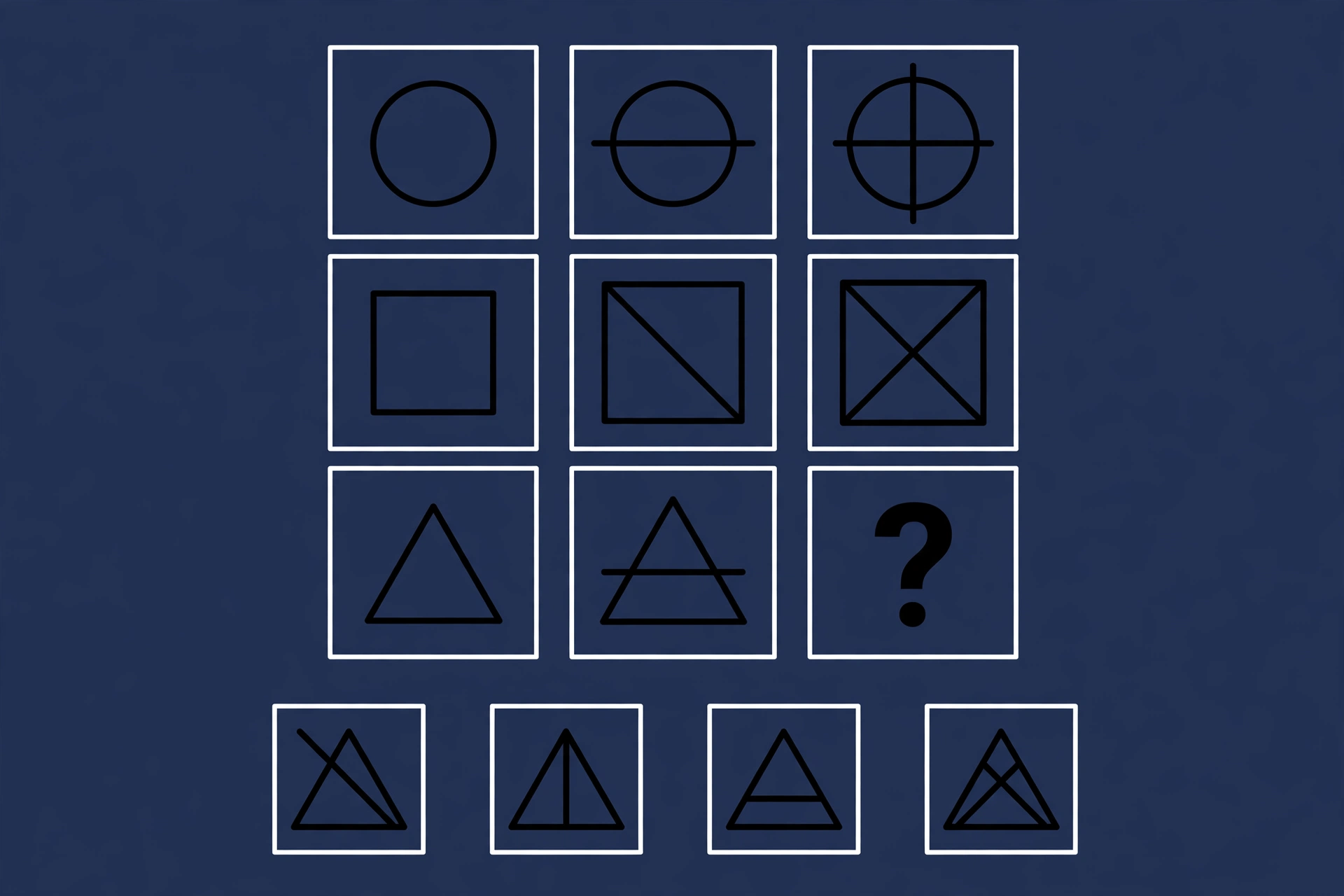
Every item is a 3 by 3 grid with the bottom-right cell missing, and six or eight answer tiles below it. Three kinds of rule cover most items. Distribution of three: each row and column contains the same three shapes, once each. Quantitative progression: a feature, such as the number of dots, rises or falls by a fixed step. Figure addition and subtraction: the third tile in a row is made by combining the first two, with shared lines removed (XOR) or kept (OR). Work through the rules in that order, and test your answer against every row and column before you choose. Our guide to how to solve pattern recognition tests explains the same method step by step, and the 5 geometric rules in abstract reasoning cover each rule with a worked example.
How to Prepare
Practice timed matrices daily, learn the five geometric rules, and always read the explanation after a wrong answer. Ten focused sessions are enough to move most candidates up a full tier.
Worked Example: Distribution of Three
Look at this grid. Each cell holds one shape.
Count the shapes in row one: one square, one triangle and one circle. Row two holds the same three shapes in a different order. So each row contains each shape exactly once. Row three already holds a circle and a square, so the missing cell must hold a triangle. Check the columns: column one holds a square, a triangle and a circle; column two holds a triangle, a circle and a square; column three holds a circle, a square and the missing triangle. The rule fits every row and every column, so the answer is a triangle. This rule, called distribution of three, appears in a large share of Ravens Progressive Matrices items, so learn to spot it first.
Practise this rule on our Ravens Matrices Practice page, and read the 5 geometric rules in abstract reasoning for the other rules that appear alongside it.
What Your Score Means
Ravens Progressive Matrices are scored by comparing you with people of your age, because raw scores rise through childhood and fall slightly in later life. Your result is usually given as a percentile: a score at the 90th percentile means you answered better than 90 in 100 people of your age. Employers and researchers use these percentiles, not the raw count, to make decisions.
Ravens scores correlate strongly with general intelligence, often around 0.7 to 0.8 with full-scale IQ, which is why the test is used as a short measure of fluid intelligence. Even so, Ravens Progressive Matrices are not a full IQ test: they measure one ability, non-verbal reasoning, and they say nothing about vocabulary, memory or processing speed. A high Ravens score is a strong signal, but it is not a complete IQ profile. The background of the test is described in detail in the Ravens Progressive Matrices article on Wikipedia.
Common Mistakes on Ravens Matrices
- Checking only rows. In Ravens Progressive Matrices the rule must also work down the columns. An answer that fits the rows but breaks a column is wrong.
- Guessing from the answer tiles. Work out the missing tile first, then look at the options. Reading the options first invites you to choose the tile that looks most complete.
- Counting only shapes. Size, shading, number and position are separate features, and the rule often sits in the feature you ignored.
- Rushing the early sets. The easy items build your confidence and your pace. A careless error on an easy item costs the same as a miss on a hard one.
- Assuming one rule per item. Hard items combine two rules, such as distribution of three plus a rotation. If one rule explains only part of the grid, look for a second rule.
Frequently Asked Questions
Is Ravens Progressive Matrices an IQ test?
It is a test of fluid intelligence, which is one part of IQ. Ravens Progressive Matrices are used inside many full IQ batteries, but on their own they are not a complete IQ test, because they do not measure vocabulary, memory or processing speed.
What is a good score on Ravens Progressive Matrices?
A percentile of 90 or above is a strong result for most purposes, and a percentile above 95 is excellent. Average is the 50th percentile by definition. Employers usually look at the percentile, not the raw number of correct answers.
How long does the Ravens test take?
The Standard version usually takes 40 to 60 minutes, and many administrations have no strict time limit. The Advanced version, Set II, is timed at 40 minutes. The Coloured version takes about 15 to 30 minutes.
Can you prepare for Ravens Progressive Matrices?
Yes. The items follow a small set of rules, so practising with those rules raises most scores. Ten focused practice sessions, with every mistake reviewed, are enough to move most candidates up a full tier.
Do Ravens Matrices favour any age or language?
The items use shapes alone, so they do not depend on language or schooling. Scores are compared with people of your own age, because matrix ability changes across the lifespan.
Now try what you have learned. Take the free pattern recognition test on our homepage, and work through a full set on our Ravens Matrices Practice page. If you are preparing for an employer test, read our SHL inductive reasoning test preparation guide next.


