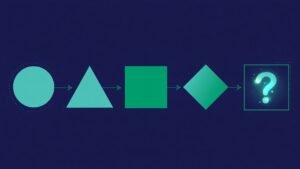
Almost every abstract reasoning matrix is built from five geometric rules. Learn to spot each one in seconds on our visual pattern recognition test.
Rule 1: Quantitative Progression
Count first. If dots, lines or sides increase by a constant step (+1, +2) across a row, the missing tile continues that step. Example: 2, 4, 6 dots in a row means the next tile has 8 dots.
Rule 2: Angular Rotation
Track one pointer. Arrows and markers rotate 45, 90 or 180 degrees per step. Verify the angle in Row 1, confirm it in Row 2, then apply it to Row 3.
Rule 3: Spatial Translation
Follow one object. A dot or shape moves around corners, edges or grid slots, one step at a time. Ignore every other element while you trace it.
Rule 4: Boolean Superposition
Overlay the first two tiles. If the third tile has every line from both, the rule is OR. If shared lines disappear and only non-shared lines remain, the rule is XOR.
Rule 5: Latin Square Permutation
Each row and column contains each shape and each fill exactly once. Use elimination: find which shape and shading is missing from the final row.
How to Combine Rules Under Time Pressure
Hard matrices layer two rules at once, for example rotation plus shading. Solve one rule completely, eliminate answers that break it, then solve the second rule among the survivors. Never try to track both rules at the same time from the start.
Geometric Rules in Abstract Reasoning: The 10 Pattern Types at a Glance
The five rules above cover most items, but test makers combine the geometric rules in abstract reasoning into a wider set of pattern types. The table below lists the ten types you will meet most often in abstract reasoning tests, including the SHL inductive reasoning test and Ravens Progressive Matrices. Learn to name the type before you solve the item: naming it tells you exactly what to count or trace.
| Pattern type | What changes | How to spot it |
|---|---|---|
| Rotation | An arrow or shape turns | Track one pointer; check 45, 90 or 180 degrees per step |
| Reflection | A shape is mirrored | Flip the shape left to right, or top to bottom, and compare |
| Counting | The number of dots, lines or sides rises or falls | Count one feature per row and look for a steady step |
| XOR and OR | Lines combine or cancel | Overlay two tiles: shared lines vanish (XOR) or stay (OR) |
| Addition and subtraction | Shapes are added or removed | The third tile is the sum of the first two, minus what they share |
| Distribution of three | Each row holds the same three elements | Each shape appears exactly once in every row and column |
| Progression | A feature grows by a fixed step | Size, sides or shading change by the same amount each step |
| Movement | An element travels around the grid | Follow one dot or shape from cell to cell |
| Shading | Black, white or striped fills cycle | Treat shading as a feature, not decoration |
| Size change | An element grows or shrinks | Compare the same element across a row, not across the whole grid |
Most hard items use two types at once, for example rotation plus counting, or movement plus XOR. When one type explains only part of a grid, look for a second type in the feature you have not checked yet. Our guide to how to solve pattern recognition tests shows a six-point checklist for working through these types in order.
Counting: Sides, Angles and Enclosed Areas
Counting is the most reliable of the geometric rules in abstract reasoning, because numbers do not lie and are quick to check. When a grid looks too complex to read, stop looking at the shapes and start counting. Three counts solve a large share of hard items.
| Count this | What it tells you | Example |
|---|---|---|
| Number of sides | Triangles have 3, squares 4, pentagons 5 | 3, 4, 5 across a row means the next shape has 6 sides |
| Number of dots or elements | Elements appear, disappear or grow | 2, 3, 4 dots across a row means 5 dots in the missing cell |
| Enclosed areas | Regions inside a shape rise or fall | 1, 2, 3 enclosed areas across a row means 4 in the missing cell |
| Intersection points | Lines cross a fixed number of times | 2, 4, 6 intersections means the next tile has 8 |
Count the same feature in all three cells of a row before you count anything else. If the counts form an arithmetic sequence, such as 3, 5, 7 or 6, 4, 2, you have the rule. If they do not, count a different feature. Never count two features at once: that is how the eye is tricked. Our number sequence formulas and tricks guide explains the sequences these counts follow.
Worked Example: An Arrow That Turns 90 Degrees
Look at this row. One arrow turns a little further at each step.
Work through the rule. The arrow in the first cell points right. In the second cell it points down, which is 90 degrees clockwise from right. In the third cell it points left, another 90 degrees clockwise. In the fourth cell it points up, another 90 degrees clockwise. So the next arrow must turn another 90 degrees clockwise from up, and point right again. The answer is a right-pointing arrow. Rotation items are solved the same way every time: measure the turn between the first two cells, then check that the same turn applies between cells two and three. If the turn is not constant, the rule is not rotation, and you should count or overlay instead.

How to Use the Five Rules in Order
Under time pressure, check the rules in this order: count first, then rotation, then movement, then XOR, then elimination. Counting is fastest and needs no imagination. Rotation needs one pointer tracked across a row. Movement needs one object followed. XOR needs two tiles overlaid. Elimination needs only the answer options. If a rule explains every cell, stop and answer. If it explains only some cells, move to the next rule in the order. This order is the practical side of the geometric rules in abstract reasoning, and it is also the order taught in our how to solve pattern recognition tests guide. Practise it on the free inductive reasoning test and the abstract reasoning test until the order feels automatic.
Common Mistakes With Geometric Rules
These errors appear in almost every practice set, and they are all avoidable. Abstract reasoning tests reward a method, not inspiration, so a fixed order of checks beats a clever guess.
- Mixing up rotation and reflection. A shape turned 180 degrees is not the same as a shape mirrored. Check the direction of the turn before you decide.
- Forgetting that shading counts. A black triangle and a white triangle are different elements. If you ignore shading, distribution of three will look wrong.
- Overlaying the wrong pair. XOR uses the first two tiles of a row to predict the third. Overlaying tiles from different rows gives a nonsense answer.
- Counting the wrong feature. If the counts do not form a sequence, you are counting the wrong thing. Switch from sides to dots, or from dots to enclosed areas.
- Stopping at the first rule that fits one row. A rule must fit all three rows and all three columns. Test it twice before you answer.
Frequently Asked Questions
How many geometric rules are there in abstract reasoning?
Five core rules cover most items: counting, rotation, movement, XOR and elimination. Test makers combine them into about ten pattern types, which are listed in the table above. Learning the five rules is enough for most tests.
Which geometric rule should I check first?
Counting. Count dots, sides or enclosed areas in one row. It is the fastest check and it needs no imagination. Move to rotation and movement only when counting gives no sequence.
What is the XOR rule in plain English?
Overlay the first two tiles of a row. Lines that appear in both tiles disappear, and lines that appear in only one tile stay. The result is the third tile. If shared lines stay instead, the rule is OR, not XOR.
Are abstract reasoning tests hard?
They feel hard at first because the rules are unfamiliar, not because the maths is hard. Most candidates improve fast once they learn the five rules: the same rules appear in almost every test, including SHL, Ravens and UCAT abstract reasoning.
How can I practise geometric rules?
Use timed practice and review every mistake by naming the rule that was missed. Our free pattern recognition test and abstract reasoning test both use these rules, and the SHL inductive reasoning test preparation guide shows how they appear under time pressure.
Put the five rules to work now. Take the free pattern recognition test on our homepage and name the rule behind every answer you choose. When you can name the rule, you have learned the geometric rules in abstract reasoning properly.