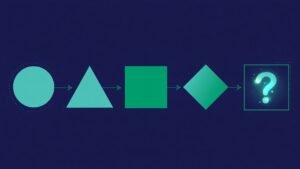
A non-verbal reasoning test practice guide is only useful if it does what the test itself does: it makes you work with shapes, not words. This guide gives you that work. You get the seven question families every major test uses, a six-feature checklist that finds the rule in seconds, ten original worked practice questions with full explanations, timing targets for each family, a scoring table, and a two-week plan you can start today. Try the free pattern recognition test on our homepage first so you know your starting level, then practise on our abstract reasoning test page.
Non-verbal reasoning tests measure how well you spot patterns in pictures. No words, no numbers to calculate, no general knowledge. You are shown shapes that change according to a hidden rule, and you must find the rule and pick the figure that follows it. Employers use these tests in hiring, schools use them in 11+ and entrance exams, and psychologists use them to measure fluid intelligence. The good news is that the skill is highly trainable. The rules repeat, and once you can name them, your score moves fast.
What the free practice pages get wrong
Before writing this guide I reviewed the five most visible free non-verbal reasoning practice pages. Four of the five were built for one exam only: two for military screening, one for Indian railway exams, one for the UK 11+. The fifth was a 250-question PDF behind a download wall. None of them offered a timed, exam-neutral practice set with worked explanations for a general reader, and none gave timing targets per question type or a study plan. That is the gap this guide fills. Everything here works whether your test comes from SHL, GL Assessment, an 11+ board, or an employer assessment, because the underlying rules are the same everywhere.
The seven question families
Every non-verbal reasoning question belongs to one of seven families. Learn to name the family in the first two seconds, and half the work is done. The timing targets below come from published 11+ and SHL practice guidance, and they are realistic once the family is familiar.
| Family | What you do | Target time |
|---|---|---|
| Series | Find what changes from one figure to the next | 30 to 40 seconds |
| Matrices | Find the rule across rows and down columns | 40 to 50 seconds |
| Odd one out | Find the rule three figures share | 15 to 20 seconds |
| Analogies | Apply the first pair’s change to the second pair | 30 to 40 seconds |
| Rotation and reflection | Turn or mirror a figure in your head | 30 to 40 seconds |
| Codes | Match each letter or symbol to one feature | 40 to 60 seconds |
| Cubes and nets | Fold a flat net into a cube, or count hidden cubes | 50 to 60 seconds |
Series and matrices dominate most tests, so they deserve most of your practice time. Odd-one-out questions are the quickest wins: they are usually worth the same single mark as a hard matrix, but they take a third of the time.
The six-feature checklist that finds the rule
When a question looks like random shapes, run this checklist in order. Tutors call it SPANSS: Shape, Position, Angle, Number, Shading, Size. Check one feature at a time and never try to see everything at once.
Shape. How many sides does each figure have? Does the outline change, or does an inner shape swap for another? A triangle becoming a square is a shape rule, and it often runs in a simple sequence such as 3, 4, 5, 6 sides.
Position. Where does each element sit? A dot that moves one corner clockwise each step is a position rule. Track one element at a time and ignore the rest until its path is clear.
Angle. Which way does the figure point, and how far does it turn? Common turns are 45, 90 and 180 degrees. A 90-degree clockwise turn repeated four times brings a figure back to where it started.
Number. How many of each element are there? Counts usually rise or fall by a fixed step, such as 1, 2, 3, 4 dots, or double each time. Count carefully: miscounted dots and lines lose easy marks.
Shading. Is each part filled, empty, striped or dotted? Shading often alternates, or moves around the figure, or fills one more section per step.
Size. Does anything grow or shrink? Size rules are often combined with a second rule, so check size last, after the easier features have been ruled out.
Say the rule out loud in a full sentence before you look at the options. “The arrow turns 90 degrees clockwise each time” is a testable claim. “It looks like B” is a guess. If you cannot say the rule, you have not found it yet.
Non-verbal reasoning test practice: 10 worked questions
Work through these under timed conditions: 30 seconds each, 5 minutes for the set. Cover the answers, attempt every question, then read the explanation for each one, including the ones you got right. Each question is described in words so you can follow it without a diagram.
Question 1, series, easy. A square gains one diagonal line per step: first a plain square, then a square with one diagonal, then a square with two diagonals. What comes next? Answer: a square with three diagonals. The rule is one element added per step, and the count runs 0, 1, 2, 3.
Question 2, number, easy. Four circles contain 1, 2, 3 and 4 dots in turn. How many dots does the next circle hold? Answer: 5 dots. Count rules are the most common easy questions on any paper, and they reward careful counting over cleverness.
Question 3, rotation, easy. An arrow points up, then right, then down. Where does it point next? Answer: left. The arrow turns 90 degrees clockwise each step, and after four turns it returns to up.
Question 4, odd one out, easy. Four shapes are shown: a circle, a square, a triangle and a rectangle. Which is the odd one out? Answer: the circle. It is the only shape with no straight sides and no corners. The other three share straight edges.
Question 5, shading, medium. A square is shaded in quarters that grow: first one quarter shaded, then one half, then three quarters. What comes next? Answer: the fully shaded square. The shaded area grows by one quarter per step, running 1, 2, 3, 4 quarters.
Question 6, analogy, medium. A small empty circle becomes a large filled circle. A small empty square should become what? Answer: a large filled square. Apply both changes from the first pair, size and shading, to the second pair. The most common wrong answer applies only one of the two changes.
Question 7, reflection, medium. The letter L faces right. What does its mirror image look like? Answer: an L whose foot points left. A mirror flips left and right but not top and bottom. Rotation can never produce a mirror image, no matter how far you turn the shape.
Question 8, matrix, medium. In a 3 by 3 grid, each row contains one circle, one square and one triangle, in some order. The bottom row shows a circle and a square, with the third cell missing. What belongs in the missing cell? Answer: a triangle. Each row and each column must contain all three shapes exactly once, so the missing shape is the one the row does not yet have.
Question 9, series, hard. A shape gains one side per step while its inner dot moves one corner clockwise per step: a triangle with a dot at the top, a square with a dot at the right, a pentagon with a dot at the bottom. What comes next? Answer: a hexagon with a dot at the left. Two rules run at the same time, and half right is still wrong, because the test prints an option for each half rule.
Question 10, codes, hard. Three figures are labelled A, B and C. Figure A is a large striped circle, figure B is a small striped square, figure C is a large plain circle. If the code letter changes with size and shading, what does a small plain square look like in code? Answer: it carries the code for small and plain, which is the opposite of A on both features. Code questions are solved one feature at a time: match one letter to size, another to shading, then combine them.
How to score yourself
Score the ten questions above out of 10, then read your band honestly. The bands below assume you kept to the 30-second limit. If you took longer, subtract one band: speed is part of the skill, not a bonus.
| Score out of 10 | What it means | Next step |
|---|---|---|
| 9 to 10 | Strong. You name rules quickly and reliably. | Move to full timed papers and harder matrices. |
| 7 to 8 | Good. One family is costing you marks. | Find that family and drill it for a week. |
| 5 to 6 | Developing. You see some rules but miss combined ones. | Follow the two-week plan below. |
| 0 to 4 | Starting out. The checklist is not yet automatic. | Practise one family a day, untimed, until you can say each rule aloud. |
For a fuller timed workout, try our matrix reasoning practice questions and our Raven’s Progressive Matrices explained guide, which covers the best-known non-verbal test in detail. If your test is an SHL assessment, our SHL inductive reasoning preparation guide covers that format specifically.
Your two-week plan
Fifteen minutes a day beats a three-hour weekend session. Short, frequent practice is what makes the checklist automatic.
| Days | Focus | Daily task |
|---|---|---|
| 1 to 2 | Series and odd one out | 20 questions, untimed, saying each rule aloud |
| 3 to 4 | Rotation and reflection | 20 questions, untimed, then 10 timed at 40 seconds |
| 5 to 6 | Matrices | 15 questions, rows first then columns, timed at 50 seconds |
| 7 | Review day | Redo every question you got wrong this week |
| 8 to 9 | Analogies and codes | 20 questions, one feature at a time |
| 10 to 11 | Cubes and nets | 15 questions, folding the net in your head |
| 12 to 13 | Mixed timed papers | Two full 25-question sets at 30 seconds each |
| 14 | Test day rehearsal | One full paper under real conditions, then review every error |
Track two numbers each day: your accuracy and your average seconds per question. Both should improve. If accuracy rises but time does not fall, you are overthinking easy questions. If time falls but accuracy drops, you are guessing. The goal is both numbers moving together.
Five mistakes that cost easy marks
Choosing the option that looks most like the question. Wrong options are designed to look similar. A real rule eliminates four options; visual similarity eliminates none.
Finding one rule and stopping. Hard questions run two rules at once. Always check a second feature after the first rule fits, especially on series and matrix questions.
Confusing rotation with reflection. A mirror image is not a shape turned a long way. No amount of rotating will ever put a reflected shape back, so test reflection separately from rotation.
Skipping the answer options. Look at the options early. They often tell you which feature the question is testing, because the options differ in only one or two features.
Getting stuck on one question. If you cannot spot the rule in 15 seconds, mark the question and move on. Come back with fresh eyes after the easy marks are banked. One hard question is worth the same single mark as three easy ones.
What to practise next
After this guide, the highest-value next step depends on your test. For general matrix skill, read our abstract reasoning test tips. For timed number patterns, try the number pattern test. For a free worked answer key from a university practice paper, the maths support centre at Loughborough University publishes a non-verbal reasoning practice test answer key with a rule-by-rule explanation for every question.
Frequently asked questions
How long should I practise for a non-verbal reasoning test? Two weeks of 15-minute daily sessions is enough to learn the families and the checklist. Four weeks is better if your test includes cubes and codes, which take longer to learn. Cramming the night before helps almost nothing, because the skill is recognition speed, not memorised facts.
Can you improve non-verbal reasoning, or is it fixed ability? It improves with practice. The tests measure pattern recognition, and pattern recognition is a learned skill built from repeated exposure to the same rule families. Scores typically rise fastest in the first two weeks, when the checklist becomes automatic.
What is a good score on a non-verbal reasoning test? Most employers and schools compare you with other candidates, not with a fixed pass mark. Scoring above 70 percent on timed practice usually puts you in a competitive range. Check your test provider’s norms if it publishes them, and aim for the top quarter rather than a bare pass.
Are non-verbal reasoning tests the same as IQ tests? They overlap but they are not the same thing. Non-verbal reasoning is one part of fluid intelligence, which IQ tests also measure. A non-verbal test uses only shapes and patterns, while a full IQ test adds verbal, numerical and memory tasks. Our inductive reasoning test page explains how the two relate.
Non-verbal reasoning test practice works when it is deliberate: one family at a time, the rule said out loud, every error reviewed, and the clock running. Start with the ten questions above, score yourself honestly, then follow the two-week plan. Your second attempt at the same set should feel noticeably faster, and that feeling is the skill forming.