Intro
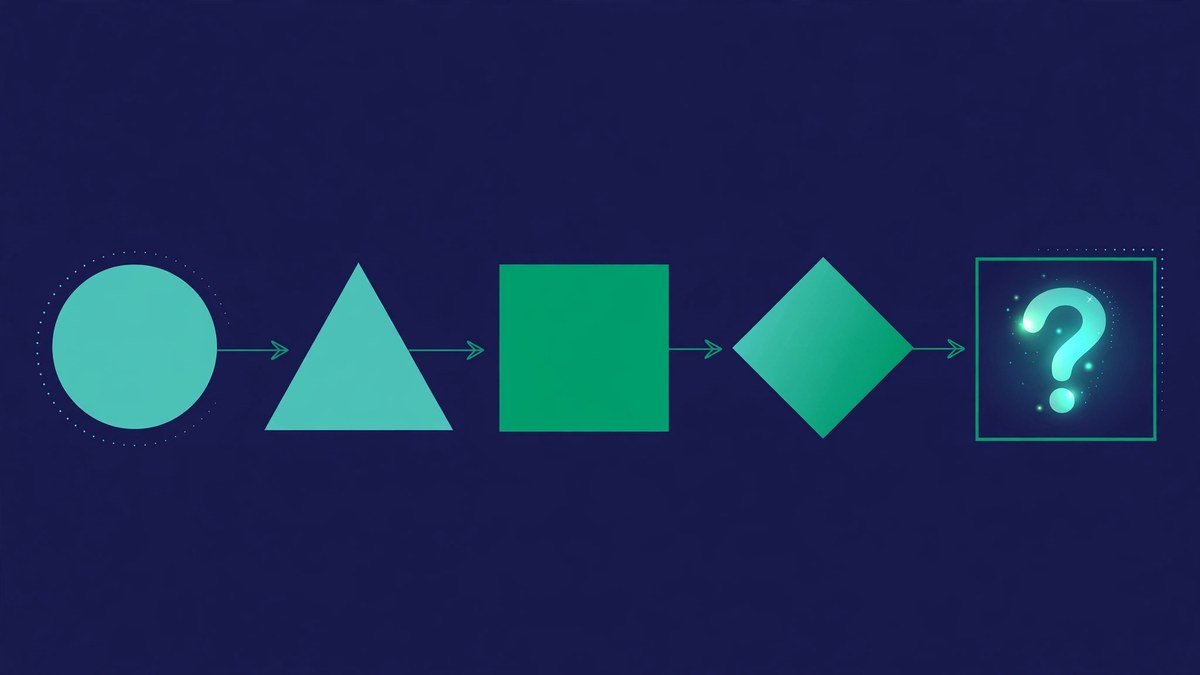
An inductive reasoning test asks you to look at a set of shapes, numbers or letters, find the rule that connects them, and use that rule to predict what comes next. It is one of the most common pre-employment tests in the world, and it rewards method far more than raw talent. Before you read on, take the free pattern recognition test on our homepage as a timed warm-up, because it uses the same visual thinking under the same kind of pressure. Then come back here and work through the five rules, the provider formats and the 10 original practice questions below. For hands-on practice after this guide, try our free inductive reasoning test, which gives you timed questions with full explanations.
What Is an Inductive Reasoning Test?
Inductive reasoning is the process of working out a general rule from specific examples. You are shown several examples that follow a hidden rule, and you must find the rule and apply it to a new case. A number series such as 2, 4, 8, 16 follows the rule “double the previous number”, so the next number is 32. A shape series follows a rule such as “rotate 90 degrees clockwise each step”. The test measures how quickly and accurately you can spot those rules.
Employers use inductive reasoning tests because the skill transfers directly to real work. A software engineer spots the pattern in a failing system from a handful of error logs. An analyst finds the trend in a set of sales figures. A manager sees the rule behind a series of customer complaints. The test does not check what you know. It checks how you think when the information is new.
Inductive vs deductive vs abstract reasoning
These three terms are often mixed up, and knowing the difference saves time on test day.
Inductive reasoning moves from examples to a rule. You see the evidence first and work out the pattern. Deductive reasoning moves from a rule to a conclusion. You are given the rule first, such as “all managers in this company work on Fridays”, and you apply it to a case. Abstract reasoning is the test format most people meet, and it is usually a type of inductive reasoning test: shapes change by a hidden rule and you find it. In practice, if a test shows you a series of shapes and asks what comes next, it is testing inductive reasoning, whatever the provider calls it.
For a full guide to the shape-based format, read our abstract reasoning test tips. For the test format used by the biggest provider, read our guide on how to prepare for an SHL inductive reasoning test.
Test Formats by Provider
Inductive reasoning tests look similar across providers, but the timing and the question count differ, and that changes how fast you must work. These are the formats used by the main test providers in 2026.
| Provider | Format | Questions | Time limit | Seconds per question |
|---|---|---|---|---|
| SHL (multiple choice) | Series of shapes, pick the next one | 18 | 24 minutes | 80 |
| SHL (Interactive Inductive) | Series of shapes, drag or tap to complete | 15 tasks | 18 minutes | 72 |
| Aon / cut-e | Shape series and matrices | 20 | 15 minutes | 45 |
| Korn Ferry | Shape series, pick the next one | 24 | 18 minutes | 45 |
| Criteria | Series and matrices | 15 | 12 minutes | 48 |
| Generic practice test | Series of shapes | 10 | 10 minutes | 60 |
Two things stand out. First, the SHL multiple-choice format gives you the most time per question at 80 seconds, while Aon and Korn Ferry give you only 45 seconds. Second, every format is multiple choice with one correct answer, so eliminating wrong options is a real skill. Before your test, check the name and format on your invitation email and practise at that exact pace, not at a comfortable one.
The 5 Rules That Solve Most Questions
Almost every inductive reasoning question uses one of five rules, or a combination of two. Learn to check them in this order and you will solve most questions in under a minute.
1. Rotation
A shape turns by a fixed amount at each step, such as 45 or 90 degrees clockwise. Check the direction of one clear feature, such as an arrowhead or a notch, and see whether it turns the same amount every time.
2. Position and movement
A shape moves around a fixed path, such as clockwise around the corners of a square or along the edge of a frame. Track each moving shape separately. Many questions move two shapes at once, each by its own rule, and the trap is following only one of them.
3. Number and count
Something increases or decreases by a fixed amount: the number of dots, lines, sides or shaded cells goes 1, 2, 3, 4. Count one feature at a time and write the numbers down. The pattern is often clearer as a list of numbers than as a picture.
4. Shading and appearance
A shape alternates between shaded and unshaded, or cycles through black, grey and white. The trap is a shape that changes its shading and its position at the same time. Check appearance and position as two separate rules.
5. Sequence and cycle
Shapes repeat in a fixed cycle, such as circle, square, triangle, circle, square, triangle. When you see three or four different shapes, check whether the whole set repeats rather than looking for a change in any single shape.
When a question seems hard, it is almost always two rules at once: a shape that rotates and moves, or a count that rises while the shading alternates. Split the question into its two rules and solve each one on its own.
10 Original Practice Questions
Work through each question before reading the answer. Give yourself 60 seconds per question, which matches the pace of a standard 10-question practice test. Every question is original and written for this guide.
Question 1: Number series
Find the next number: 4, 9, 19, 39, ?
A. 69
B. 79
C. 59
D. 89
Answer: B. 79. Each number is doubled and 1 is added: 4 x 2 + 1 = 9, 9 x 2 + 1 = 19, 19 x 2 + 1 = 39, so 39 x 2 + 1 = 79. Option A adds 30, which breaks the pattern after the first step, and option C adds 20.
Question 2: Letter series
Find the next letter: A, C, F, J, ?
A. M
B. N
C. O
D. P
Answer: C. O. The gap between letters grows by one each time: A to C is 2 steps, C to F is 3, F to J is 4, so J to the next letter is 5 steps, which gives O. Option A uses a gap of 3, which would repeat the second gap instead of growing it.
Question 3: Rotation
A black arrow points north-east, then east, then south-east, then south. Which direction does it point next?
A. South-west
B. West
C. North-west
D. South
Answer: A. South-west. The arrow turns 45 degrees clockwise at each step: north-east to east to south-east to south, so the next turn gives south-west. Option B turns 90 degrees instead of 45, and option D repeats the last direction instead of turning.
Question 4: Shading cycle
A square is white, then grey, then black, then white again, then grey. What comes next?
A. White
B. Grey
C. Black
D. White and grey
Answer: C. Black. The shading cycles through three states in a fixed order: white, grey, black, white, grey, so the next state is black. Option A restarts the cycle one step too early.
Question 5: Counting shapes
A figure contains 1 triangle, then 2 triangles, then 3 triangles, then 4 triangles. How many triangles does the next figure contain?
A. 4
B. 5
C. 6
D. 8
Answer: B. 5. The count rises by 1 at each step, so the next figure has 5 triangles. Option C adds 2, and option D doubles the count, neither of which matches the steady rise.
Question 6: Alternating shapes
Find the next item: circle, square, circle, square, circle, ?
A. Circle
B. Square
C. Triangle
D. Star
Answer: B. Square. The pattern alternates between two shapes, so after a circle comes a square. Option A repeats the last shape instead of alternating, and options C and D introduce shapes the series never uses.
Question 7: 3 by 3 matrix
In a 3 by 3 grid, each row contains one circle, one square and one triangle, each in a different shading: white, grey and black. The first two rows are complete. The third row shows a white square and a black triangle. What is the missing shape?
A. White circle
B. Grey circle
C. Black circle
D. Grey square
Answer: B. Grey circle. The row must contain one of each shape and one of each shading. It already has a square and a triangle, so the missing shape is a circle. It already has white and black, so the missing shading is grey. Only option B gives a grey circle. Option A repeats the white shading that the square already uses.
Question 8: Increasing differences
Find the next number: 2, 6, 12, 20, 30, ?
A. 36
B. 40
C. 42
D. 44
Answer: C. 42. The differences between numbers grow by 2 each time: 4, 6, 8, 10, so the next difference is 12 and 30 + 12 = 42. Option A adds only 6, which repeats an earlier difference instead of continuing the growth.
Question 9: Moving dot
A dot moves clockwise around the eight positions of a square frame, two positions at each step. It starts at the top-left corner. Where is it after three steps?
A. Top-right corner
B. Middle-right
C. Bottom-right corner
D. Bottom-left corner
Answer: D. Bottom-left corner. The eight positions in clockwise order are: top-left, top-centre, top-right, middle-right, bottom-right, bottom-centre, bottom-left, middle-left. Starting at top-left, step 1 lands two positions on at the top-right corner, step 2 lands at the bottom-right corner, and step 3 lands at the bottom-left corner. Option C is where the dot sits after two steps, which is the classic trap in this question: counting the steps instead of the positions.
Question 10: Combined letter and number
Find the next item: B2, D4, F6, H8, ?
A. I9
B. J10
C. J9
D. I10
Answer: B. J10. The letters move two steps forward each time (B, D, F, H, J) and the numbers rise by 2 each time (2, 4, 6, 8, 10). Only option B matches both rules. Option D gets the number right but the letter wrong, and option A gets neither.
The 10-Minute Timed Drill
Knowing the rules is not enough. You need to use them at test pace, and the only way to build that speed is a timed drill. Here is the drill we recommend, built around the 10 questions above.
- Set a timer for 10 minutes and close this page so you cannot see the answers.
- Answer all 10 questions on paper, one minute per question.
- When the timer ends, stop, even if you have not finished.
- Mark your answers and record your score and how many questions you left blank.
The 60-second target is deliberate. It matches the pace of a standard 10-question practice test, and it sits between the fast provider formats (45 seconds per question at Aon and Korn Ferry) and the slower SHL format (80 seconds). If you can finish 10 questions in 10 minutes with 8 or more correct, you are ready for every major provider. If you finish with time left over, you are going too slowly on easy questions and too fast on hard ones: bank the easy marks first, then return to the hard ones.
Run the drill three times across a week, with a day between each run. Most candidates gain 2 to 3 marks between the first and third run, not because the questions get easier, but because the five rules become automatic and the checking order becomes a habit.
Scoring Ladder
Use this ladder to read your drill score honestly.
| Score out of 10 | What it means | What to do next |
|---|---|---|
| 9 to 10 | Test-ready | Take a full timed mock at your provider’s pace |
| 7 to 8 | Strong | Drill your weakest rule for 20 minutes a day |
| 5 to 6 | Average | Learn the five rules in order and re-run the drill |
| 3 to 4 | Needs work | Slow down, work untimed first, then add the clock |
| 0 to 2 | Start again | Study one rule at a time with worked examples |
A score of 7 or more on a timed drill is a good sign for most employers. A score of 5 or 6 means you understand the rules but lose marks to the clock, so your practice should be timed, not untimed. A score below 5 usually means one rule is missing entirely: check which questions you missed and match them to the five rules above.
7-Day Study Plan
Day 1: read the five rules and work questions 1 to 5 untimed, checking each answer as you go.
Day 2: work questions 6 to 10 untimed. Write down which rule each question uses.
Day 3: run the 10-minute drill for the first time and record your score.
Day 4: drill your weakest rule only. If rotation questions were slow, do 10 rotation questions from our free inductive reasoning test.
Day 5: run the drill a second time. Compare your score and your blank count with day 3.
Day 6: take a full mock at your provider’s pace, using the timing table above. SHL candidates use 80 seconds per question, Aon and Korn Ferry candidates use 45.
Day 7: rest, then run the drill one last time. A score of 8 or more means you are ready.
5 Common Mistakes
- Following only one moving shape. Many questions move two shapes at once. Track each shape separately or you will pick the option that is right for one shape and wrong for the other.
- Counting steps instead of positions. In movement questions, the trap answer is usually where the shape sits one step earlier or later. Count positions on the frame, not steps in your head.
- Guessing from the options. Read the series first and predict the answer before looking at the options. If you look at the options first, a plausible wrong answer will feel right.
- Spending too long on one question. At 45 seconds per question, a question you cannot solve in 90 seconds is already costing you two marks. Pick your best guess, move on, and return only if time remains.
- Practising untimed only. Untimed practice builds understanding, but the test is timed. At least half of your practice in the final three days should be against the clock.
Frequently Asked Questions
Is an inductive reasoning test the same as an abstract reasoning test?
Almost always, yes. Abstract reasoning tests are the most common format for inductive reasoning: shapes change by a hidden rule and you find it. Some providers use the name “inductive reasoning” for number and letter series too, so expect both shapes and numbers.
How long is an inductive reasoning test?
It depends on the provider. SHL gives 24 minutes for 18 questions, Aon gives 15 minutes for 20 questions, and Korn Ferry gives 18 minutes for 24 questions. Check your invitation email for your exact format and practise at that pace.
Can you prepare for an inductive reasoning test?
Yes. Scores improve with practice because the test uses a small set of rules. Learning the five rules in this guide and drilling them against the clock is the fastest preparation, and most candidates gain 2 to 3 marks in a week of timed practice.
What is a good score on an inductive reasoning test?
Most employers compare you with other candidates rather than using a fixed pass mark. Scoring in the top 30 percent is usually enough. On a 10-question timed drill, that means about 8 correct, and on a real test it means working accurately at the provider’s pace without leaving questions blank.
Final Word
An inductive reasoning test is a learnable skill, not a talent test. Learn the five rules, predict before you look at the options, and practise against the clock. Start with the free pattern recognition test on our homepage, then work through the 10 questions in this guide under the 10-minute timer. When you score 8 or more, you are ready.