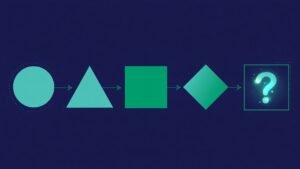
The email lands one evening: you passed the first screening, and now the employer wants you to complete an SHL inductive reasoning test within 48 hours. No syllabus, no sample paper, just a link and a deadline. Before you read another tip, take the free pattern recognition test on our homepage and time yourself. Ten questions, an 8 minute timer, and a baseline score to measure your progress against.
Most candidates fail for one simple reason: they practise the wrong thing, or they practise without a clock. This guide fixes both, with the version you are facing, how SHL scores you, the six rules behind every sequence, and a 7 day plan.
What the SHL inductive reasoning test actually is
SHL, founded in 1977, publishes pre-employment tests used by more than 10,000 organisations, including Fortune 500 companies. SHL says around 45 million of its assessments are taken every year. The inductive reasoning test is one of its Verify ability tests: it measures your ability to find patterns and predict outcomes using shapes and figures, not words or numbers.
A typical question shows a sequence of diagrams, each slightly different from the last. Spot the rule that connects them and choose the diagram that comes next. There is no vocabulary to memorise and no formula to recall. The test measures how quickly you learn a new rule from examples, which is why employers use it to predict how fast a new hire picks up unfamiliar systems.
One detail catches many candidates out: there is not one single SHL inductive reasoning test. Your invitation names the version, and the version changes the timing.
| Test version | Questions | Time limit | Seconds per question | Format |
|---|---|---|---|---|
| Verify G+ Inductive, interactive | 15 | 18 minutes | 72 | Drag and drop, activity based, adaptive |
| Verify G+ Inductive, non-interactive | 18 | 24 minutes | 80 | Multiple choice |
| CEB SHL Verify Inductive (older) | 24 | 25 minutes | 62 | Multiple choice |
Two things matter here. First, the interactive version asks you to drag lines and dots into place instead of clicking an answer, which feels very different under time pressure. If your invitation says interactive, practise that format. Second, SHL says its newer assessments are automated and remotely proctored, and ask fewer questions than the older versions.
How SHL scores you, and what score you need
Your SHL report shows no raw score. It compares you with a norm group of previous test takers and places you in one of five grade groups, from A to E, with A the highest. The raw number of correct answers is left out, because the comparison adjusts for how hard that set of questions was.
There is no strict pass or fail. Each employer sets its own unpublished cut off. As a working target, most employers look for scores around the 80th percentile and above, meaning better than about four out of five people in the norm group. Most candidates walk in unprepared, so a week of structured practice puts you ahead of the majority. On adaptive versions, a hard question often means you are doing well, and guessing beats leaving a question blank.
The six rules behind every sequence
Every SHL inductive reasoning question is built from a small set of rules. Check them in the same order every time and the test stops feeling like guesswork. Our guide to the five geometric rules in abstract reasoning covers the visual side in depth. The six rules are:
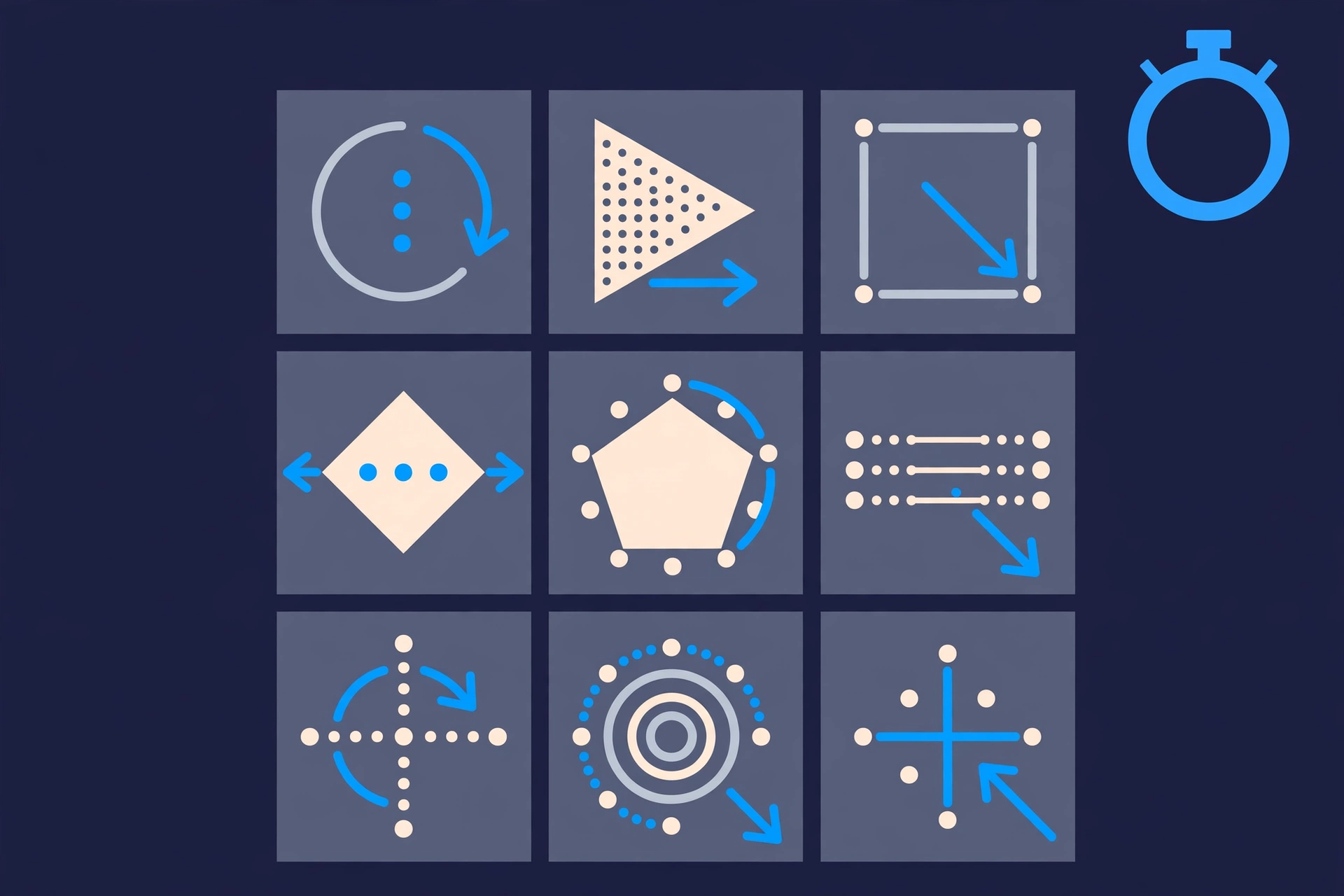
- Rotation. A shape turns a fixed amount each step, often 45 or 90 degrees.
- Counting. Dots, lines or shapes rise or fall by a fixed amount, often by one each step.
- Shading. A shape fills in, empties out, or alternates between black, white and grey.
- Size. A shape grows or shrinks step by step, or alternates between large and small.
- Position. A shape moves around the box, for example clockwise around the corners.
- Alternation. Two patterns take turns, so the rule only shows when you look at every second box.
Most real sequences hide two rules at once. A shape can rotate while the dots increase, and the wrong answers are built from half right rules. Check one feature at a time, confirm it across every box, and only then look at the options. Our step by step framework for solving pattern recognition tests shows the same method applied to full matrix grids.
Worked example: solve one together
Try this sequence before you read the answer. Four boxes, left to right: box 1 has one black dot and a triangle pointing up; box 2 has two dots and a triangle pointing right; box 3 has three dots and a triangle pointing down; box 4 has four dots and a triangle pointing left.
Counting first: the dots go 1, 2, 3, 4, a clean plus one rule, so box 5 has five dots. Rotation next: the triangle turns 90 degrees clockwise each step, so after left comes up again. Together, the answer is five black dots with a triangle pointing up.
Notice how elimination helps if you only found one rule: any option with the wrong dot count is out, whatever its triangle does, and any option with the triangle pointing the wrong way is out. Two confirmed rules usually leave only one option standing. Say the rule in words before you answer: a rule you cannot say out loud is a rule you have not really found.
The 7 day preparation plan
Other guides hand you a list of tips. A list does not tell you what to do on Tuesday. This plan does, and it is built around one number: your baseline. Short daily sessions beat one long weekend cram, because pattern recognition is a habit of attention.
Day 1: measure your baseline. Take the free inductive reasoning test on this site and the 10 question homepage test under its 8 minute timer. Note your score and your average seconds per question. Repeat the same test on day 7.
Day 2: learn the six rules. Spend 30 minutes on rotation and counting only, the two rules in almost every question. Work slowly with no timer, and write each rule in a sentence before you check the answer.
Day 3: use SHL’s own practice tests. SHL publishes free practice tests, and its own advice is to take a full length one so the format and timing feel familiar. Start at the official SHL practice tests page and complete the inductive reasoning practice in your invitation’s format. Use it to learn the format, not to predict your score.
Day 4: add the clock. Practise in sets of 10 with a timer, allowing yourself the exact seconds per question your version gives you from the table above. The goal today is finishing the set, not a perfect score.
Day 5: practise the interactive format, if it applies. If your invitation says interactive, spend today dragging answers into place, as the controls take getting used to. If your version is multiple choice, use today for your weakest rule, and keep a list of the question types you get wrong.
Day 6: full mock under real conditions. Quiet room, no phone, no notes, same device you will use on the day. Take a full timed set from start to finish, including the example questions. Then review every mistake with its worked solution.
Day 7: rest and re-test. Do one light 15 minute review of your error list, then retake the day 1 homepage test under the same 8 minute timer. Most candidates who follow this plan cut their average time per question by 10 to 15 seconds and gain at least two questions out of ten. After that, stop studying and take the real test fresh.
Timing: the 60 second rule
Time management decides more SHL results than raw ability does. Divide your time limit by the number of questions and practise to that number: 62 seconds for the 24 question version, 72 for the 15 question interactive version, and 80 for the 18 question version.
Then apply the 60 second rule. If you have stared at a question for 45 seconds without naming a rule, stop. Eliminate every option that breaks a confirmed rule, guess from what is left, and move on. One stuck question can cost you three easy ones at the end, and easy questions are worth exactly as much as hard ones.
Test day checklist
- Use the device your invitation recommends, fully charged, on a stable connection, and run SHL’s browser check with pop up blockers off.
- Read every instruction screen and complete the example questions before the timer starts. They show you the controls.
- Keep scratch paper ready if your invitation allows it, and check whether a calculator is permitted.
- If you need extra time or another adjustment, tell the employer as early as possible, as SHL says extensions need the employer’s approval.
Five mistakes that cost candidates the job
1. Practising the wrong test. Inductive and deductive reasoning are different skills, so check the name in your invitation and practise the one you were sent.
2. Skipping the example questions. They are untimed and they show you the controls. In the interactive version they are your only chance to learn the drag and drop mechanics before the clock starts.
3. Practising without a timer. An untimed score tells you nothing about test day. If you cannot solve a question in about 60 seconds, you have not learned it yet.
4. Chasing one hard question. On an adaptive test a hard question often means you are doing well, so give it your best guess and keep moving.
5. Trying to cheat. Employers can ask you to retake the test in person under supervision. A big gap between your two scores can end your application, so take the test yourself and follow the employer’s rules.
Frequently asked questions
How many questions are in the SHL inductive reasoning test? It depends on the version: up to 15 in 18 minutes for interactive Verify G+, 18 in 24 minutes for non-interactive, and 24 in 25 minutes for the older CEB SHL Verify version. Your invitation names your version.
What is a good score on the SHL inductive reasoning test? SHL reports a grade from A to E based on a comparison with a norm group, not a raw score. Most employers look for scores around the 80th percentile and above, but each employer sets its own unpublished cut off.
Start your preparation today
Preparation for the SHL inductive reasoning test is not about talent. It is about knowing your version, learning six rules, and practising them against a clock for a week. Take your baseline now on the free inductive reasoning test, follow the 7 day plan, and re-test on day 7. Our SHL inductive reasoning practice page is built for exactly this test. The candidates who pass are rarely the cleverest in the room. They are the ones who walked in knowing what was coming.
Is the SHL inductive reasoning test hard?
Yes, for most candidates it is hard, and that is by design. The SHL inductive reasoning test is not a knowledge test, so you cannot revise for it the way you would revise for an exam. Its difficulty comes from the clock: the interactive version gives you 72 seconds per question, and the non-interactive version gives you about 62 to 80 seconds per question, depending on the version. Most candidates find the early questions easy and the later questions very hard, because the test is designed to separate candidates, not to let everyone finish comfortably. A percentile above 80 is strong for most roles, and above 90 is excellent. The good news is that the difficulty is predictable: the same six rules appear in almost every question, so the preparation plan above, practised under timed conditions, is the most reliable way to raise your score. If you want a gentler warm-up first, read our guide to Ravens Progressive Matrices explained, which uses the same matrix format without a strict time limit.
Can you cheat on an SHL test?
No, not in any way that survives the process. The SHL inductive reasoning test is usually taken online with identity checks, and employers can ask shortlisted candidates to retake a short version in person under supervision. A large gap between the two scores ends the application. Some candidates ask whether AI tools can help during the test; the answer is the same. The questions are visual sequences, not text, so a chatbot cannot read them, and the time limit leaves no room to photograph and upload each item. The only reliable approach is preparation: learn the six rules, practise under timed conditions on our SHL inductive reasoning practice page, and arrive on test day knowing exactly how you will spend your 60 seconds per question.