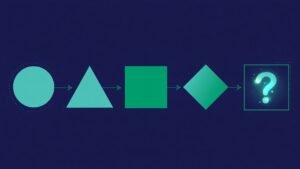
A pattern recognition test for job interviews is a short timed assessment where you find the hidden rule in shapes, symbols or numbers, then pick the figure that follows it. Employers use it to screen candidates before the interview stage, and it often decides who moves forward. Take the free pattern recognition test on our homepage to find your starting level, then practise on our abstract reasoning test page. This guide covers the formats employers actually use, how scoring works, five worked questions with full explanations, timing targets, and a seven-day plan.
Most candidates fail this test for a simple reason: they prepare for the wrong thing. They memorise puzzle types from exam books, or they confuse the test with coding interview patterns, where “pattern recognition” means spotting a known algorithm. In hiring, it means something different. You are shown unfamiliar material and asked to work out the rule nobody told you. That skill is exactly what the job needs when a new problem lands on your desk, which is why employers trust the test.
What employers are actually testing
A pattern recognition test in hiring is a form of inductive and non-verbal reasoning. You look at shapes, symbols or number sequences, find the rule that connects them, and apply it to a new case. No vocabulary, no general knowledge, no job-specific facts. The test measures fluid intelligence: how fast you learn from unfamiliar material, not what you already know.
Employers like it for three practical reasons. First, it is language-light, so a candidate’s first language matters far less than in a verbal test. Second, it is hard to fake: you either see the rule or you do not. Third, it predicts how quickly someone will pick up new systems, spot a fault in a process, or notice that a set of numbers is not behaving as it should. That is why the same test appears in hiring for analysts, engineers, consultants, finance roles, operations managers and graduate schemes, even though those jobs look nothing alike on the surface.
Who runs the test, and what format to expect
Your invitation email names the provider, and the provider sets the format. The table below lists the formats candidates meet most often. The seconds-per-question column is our own calculation from each provider’s published question count and time limit, and it is the number that should drive your practice pace.
| Provider and test | Questions | Time limit | Seconds per question |
|---|---|---|---|
| SHL Verify Interactive, Inductive Reasoning | Up to 15 | 18 minutes | 72 |
| SHL Verify G+, general ability | 30 | 36 minutes | 72 |
| HireValid Abstract Reasoning | 15 | 10 minutes | 40 |
| Pattern Recognition Test, this site | 10 | 8 minutes | 48 |
Two facts in that table matter more than the rest. First, the SHL Verify Interactive tests are adaptive: the difficulty of later questions changes with your earlier answers, so protecting accuracy matters more than chasing a rumoured raw score. Second, there is no universal pass mark. SHL states plainly that it sets none; the employer chooses a comparison group and a cutoff. Many employers screen to roughly the top 20 to 30 percent of applicants, so a score at or above the 80th percentile is generally regarded as strong. A percentile is not the share of questions you answered correctly. A 60th percentile result means you performed better than 60 percent of the comparison group.
Some employers add a verification test at the interview itself, a short supervised retest to confirm the online result was yours. Others combine the reasoning score with a personality questionnaire or a work sample into one overall job score. SHL’s sample reports also show that results stay valid for about 12 to 18 months, so a strong score can carry over if you apply to the same employer again.
The six question types you will meet
Every hiring pattern test draws from the same six families. Learn to name the family in the first two seconds, and half the work is done.
Matrices. A 3 by 3 grid of shapes with one cell missing. Find the rule that runs across the rows and down the columns, then pick the figure that completes the grid. This is the most common family in SHL and Raven-style tests.
Series. A row of figures that change step by step. Work out what changes from one figure to the next, then choose the figure that comes after the last one shown.
Odd one out. Four or five figures share a rule, and one breaks it. Find the rule the majority shares, and the odd one names itself. These are the quickest marks on the paper.
Analogies. The first pair shows a change, and you apply the same change to a second pair. If A becomes B by rotating and shading, then C must become the rotated, shaded version of itself.
Codes. Each letter or symbol stands for one feature, such as size or shading. Decode the rule from the examples, then apply it to a new figure. Codes reward working one feature at a time.
Number and letter sequences. Find the next number or letter in a series. The rule is usually a changing difference, a multiplication, or two alternating rules running at once.
How scoring works, and what counts as good
Your result is reported as a percentile against a named comparison group, often the general population or graduates, with a year attached. SHL adds a T-score, a standardised score with a mean of 50 and a standard deviation of 10, and a Sten score on a 10-point scale with a mean of 5.5, for users trained to interpret them. None of these numbers is a percentage of correct answers, and none of them is an IQ score.
What counts as good depends on the employer and the role. A graduate scheme with thousands of applicants may cut at the 70th percentile, while a specialist role may accept the 50th. The honest target is the top quarter: if you score above 70 percent on timed practice, you are in a competitive range for most roles. And remember that the test is one piece of evidence. HireValid, which builds these tests for employers, advises hiring managers to read the result next to a work sample and a structured interview, never as a verdict on its own.
Pattern recognition test for job interviews: 5 worked questions
Work through these under timed conditions: 5 questions in 4 minutes, which is 48 seconds each, the same pace as our homepage test. Cover the answers, attempt every question, then read the explanation for each one, including the ones you got right.
Question 1, series, easy. A circle is shown with spokes radiating from its centre: first one spoke, then two spokes, then three spokes. How many spokes does the next circle have? Answer: four spokes. The rule is one element added per step, and the count runs 1, 2, 3, 4.
Question 2, matrix, medium. In a 3 by 3 grid, each cell holds a number of dots, and the dots in each row add up to 6. The first row shows 1, 2 and 3 dots. The second row shows 2, 2 and 2 dots. The third row shows 3 dots, then 1 dot, then a missing cell. How many dots belong in the missing cell? Answer: 2 dots. The third row must also add up to 6, and 3 plus 1 plus 2 equals 6. Always check the columns too: here the columns add up to 6 as well, which confirms the rule.
Question 3, odd one out, easy. Four shapes are shown: a circle, a semicircle, a triangle and a square. Which is the odd one out? Answer: the triangle. It is the only shape with no curved edge at all. The circle is fully curved, the semicircle is partly curved, and even the square shares a straight edge with the triangle, so straight sides are not the rule. The most common wrong answer is the semicircle, because it looks different, but looking different is not a rule.
Question 4, analogy, medium. An arrow pointing up turns 90 degrees clockwise and points right. An arrow pointing left turns 90 degrees clockwise. Where does it point? Answer: up. A 90-degree clockwise turn moves left to up, up to right, right to down, and down to left. Apply the same single change from the first pair to the second pair, and nothing else.
Question 5, number sequence, medium. The numbers run 2, 6, 12, 20, 30. What comes next? Answer: 42. The differences between the numbers are 4, 6, 8 and 10, and each difference grows by 2. The next difference is 12, and 30 plus 12 equals 42. When a sequence does not follow one simple step, always check the differences between the numbers before trying anything clever.
The four-step method that works on every question
Use the same method on every question, easy or hard. A fixed method is faster than inspiration, and it stops you from guessing under time pressure.
Step 1, name the family. Matrix, series, odd one out, analogy, code or sequence. Two seconds, no more. The family tells you where the rule lives.
Step 2, check one feature at a time. Shape, number, shading, position, rotation, size. Pick one feature and track it through every figure before moving to the next. Trying to see everything at once is how easy questions get missed.
Step 3, say the rule out loud. “The arrow turns 90 degrees clockwise each time” is a testable claim. “It looks like B” is a guess. If you cannot say the rule in a full sentence, you have not found it yet.
Step 4, test the rule against the options. A real rule eliminates the wrong options. If two options still fit, your rule is incomplete, and a second feature is running alongside the first. Hard questions almost always run two rules at once.
Timing strategy: where the marks actually are
Every question is worth the same single mark, so time is the real currency of the test. Odd-one-out questions take 15 to 20 seconds and are worth as much as a hard matrix that takes 50 seconds. Bank the quick marks first, then spend your remaining time on the hard ones.
| Question family | Target time | What to do if you are stuck |
|---|---|---|
| Odd one out | 15 to 20 seconds | Move on after 20 seconds, it is one mark |
| Series | 30 to 40 seconds | Check the differences, then the features |
| Analogies | 30 to 40 seconds | Apply one change at a time |
| Matrices | 40 to 50 seconds | Rows first, then columns, then both |
| Codes | 40 to 60 seconds | Decode one feature, then combine |
| Number sequences | 30 to 40 seconds | Check the differences first |
If you cannot spot the rule in 15 seconds, mark the question and move on. Come back with fresh eyes after the easy marks are banked. On an adaptive test this matters even more: a wrong answer early can lower the difficulty of the questions that follow, while a steady, accurate pace keeps you in the harder, higher-scoring items.
Your seven-day plan
Fifteen minutes a day beats a three-hour weekend session. Short, frequent practice is what makes the method automatic.
| Days | Focus | Daily task |
|---|---|---|
| 1 | Families and method | Learn the six families, practise naming each one in 2 seconds |
| 2 | Series and odd one out | 20 questions, untimed, saying each rule aloud |
| 3 | Matrices | 15 questions, rows first then columns, timed at 50 seconds |
| 4 | Analogies and codes | 20 questions, one feature at a time |
| 5 | Number sequences | 20 questions, differences first, timed at 40 seconds |
| 6 | Mixed timed paper | One full 25-question set at 45 seconds each |
| 7 | Test day rehearsal | One full paper under real conditions, then review every error |
Track two numbers each day: your accuracy and your average seconds per question. Both should improve. If accuracy rises but time does not fall, you are overthinking easy questions. If time falls but accuracy drops, you are guessing. The goal is both numbers moving together.
Five mistakes that cost easy marks
Preparing for coding patterns instead of reasoning patterns. The 14-pattern LeetCode framework is a fine way to prepare for a software interview, but it has nothing to do with a psychometric pattern test. Practise shapes and sequences, not algorithms.
Choosing the option that looks most like the question. Wrong options are designed to look similar. A real rule eliminates four options; visual similarity eliminates none.
Finding one rule and stopping. Hard questions run two rules at once. Always check a second feature after the first rule fits, especially on series and matrix questions.
Confusing rotation with reflection. A mirror image is not a shape turned a long way. No amount of rotating will ever put a reflected shape back, so test reflection separately from rotation.
Getting stuck on one question. One hard question is worth the same single mark as three easy ones. If the rule has not appeared in 15 seconds, move on and come back.
What to practise next
After this guide, the highest-value next step depends on your test. If your invitation names SHL, read our SHL inductive reasoning preparation guide, which covers that format in detail. For more matrix practice, try our matrix reasoning practice questions. For the wider skill behind every format, our non-verbal reasoning test practice guide gives you ten more worked questions, and our Raven’s Progressive Matrices explained guide covers the best-known non-verbal test. To see how employers read the result, the HireValid abstract reasoning test page explains the employer side, including scoring and fairness. For a timed drill in the same format as the real test, try our inductive reasoning test and our number pattern test.
Frequently asked questions
What is a pattern recognition test for job interviews? It is a short timed assessment where you find the hidden rule in shapes, symbols or number sequences and pick the figure that follows it. Employers use it to screen candidates before the interview stage, because it measures how quickly you learn from unfamiliar material.
Which companies use pattern recognition tests in hiring? Most large employers that run volume hiring use one, usually through a provider such as SHL, Criteria, Aon, Saville or HireValid. Your invitation email names the provider and the test, and the format depends on that provider, not on the employer alone.
How long does a pattern recognition test take? It depends on the provider. SHL Verify Interactive Inductive Reasoning allows up to 15 questions in 18 minutes, about 72 seconds per question. HireValid’s abstract reasoning test gives 15 questions in 10 minutes, about 40 seconds per question. Always check your own invitation, because the employer can change the settings.
What is a good score on a pattern recognition test? There is no universal pass mark. Scores are reported as percentiles against a comparison group, and each employer sets its own cutoff. A score at or above the 80th percentile is generally regarded as strong, and scoring above 70 percent on timed practice puts you in a competitive range for most roles.
Can you prepare for a pattern recognition test, or is it fixed ability? You can prepare, and preparation moves scores fast. The tests measure pattern recognition, and pattern recognition is a learned skill built from repeated exposure to the same rule families. Two weeks of 15-minute daily sessions is enough to learn the families and the method. Cramming the night before helps almost nothing, because the skill is recognition speed, not memorised facts.
Do employers retest you at the interview? Some do. A short supervised verification test at the interview confirms the online result was yours. This is routine, not an accusation, and the same preparation covers it.
A pattern recognition test for job interviews rewards method, not talent. Learn the six families, practise one feature at a time, say each rule out loud before you look at the options, and keep the clock in view. Start with the five questions above, score yourself honestly, then follow the seven-day plan. Take the free pattern recognition test again at the end of the week and compare your time and your score. The second attempt should feel noticeably faster, and that feeling is the skill forming.